
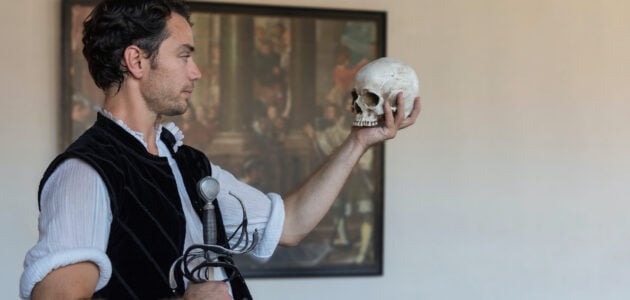
Hamlet Monologue (Act 2 Scene 2)
Comparison is the death of joy, right? Well, Hamlet certainly isn’t the most joyous of Shakespeare’s characters, but in this moment, comparison really ruins his day. We are right in the thick of this play at this moment, Act 2- Scene 2. Today, we’ll be looking at one of the most iconic soliloquies from Hamlet. It’s a terrific monologue to demonstrate energetic range and intelligent choices. But take note – this is the largest soliloquy in Hamlet; it is no small task preparing and delivering these words effectively! Here we’ll be unpacking the monologue, looking at how it sits in the play and for this character, and talk about how we may best be able to perform it.
Context
So: Act 2, Scene 2. Where are we? Well, as is ALWAYs advised with any monologue, but particularly in Shakespeare, now is the time for you to read the play if you haven’t already. Reading Shakespeare may be challenging, yes, but the only way you can develop the skill is through practice. If you want to be able to take the next step and actually perform Shakespeare, reading and understanding the given circumstances and language is the first step on the journey.
To recap for those of you familiar with the story of Hamlet, this soliloquy, beginning “O what a rogue and peasant slave am I” (How’’s that for self talk? This guy needs some therapy – STAT) comes at the end of a huge scene for the actor playing Hamlet. Hamlet has, in act one, been visited by the ghost of his Father, who orders him to kill his uncle Claudius because Claudius murdered him. Claudius, Hamlet’s uncle, is now married to Hamlet’s Mother, Gertrude.
In this scene, we (the audience) see the first indication that Hamlet has in fact adopted an ‘antic disposition’ like he said he would at the end of Act 1. Hamlet is said to have been acting VERY strangely: visiting Ophelia starkly dressed and pale as a sheet, silently reaching out to her then wandering off like he was sleepwalking is one example of his notedly strange behavior. In this scene, Hamlet has been accosted and approached by various members of the court who are trying to diagnose him. First came Polonius, the old and bumbling advisor to The King and Queen, next came Rosencrantz and Guildenstern, Hamlets ‘friends’ turned spies of the King, and finally came a convenient visit from The Players: a traveling troupe of actors who Hamlet has enjoyed watched perform in the past.
It is one of these actors who sends Hamlet into a spiral of despair, prompting this incredible soliloquy. The actor performs a piece for him (Hamlet gives it the title “Aeneas tale to Dido ”) about Priam and his wife, Hecuba, taken from The Iliad of Greek Myth. In this speech the actor depicts the murder of a man and his wife (Hecuba’s) reaction to the man’s slaughter. The actor must perform well, because Polonius, who has already complained about the acting being boring, has been deeply moved by this piece about Hecuba, stating, “Look, where he has not turned his colour and has tears in’s eyes. Pray you, no more.” What Polonius is describing is the emotion which has welled up in the actor’s eyes due to his performance. (Maybe we all could take some acting tips from this guy, hey?)
Promptly Hamlet shoo’s and dismisses the people around him, and finally he has a moment alone to process all which has just happened and this moving performance, and how that reflects on him and his delayed vengeance for his Father.
Original Text Hamlet Act II Scene II
O, what a rogue and peasant slave am I!
Is it not monstrous that this player here,
But in a fiction, in a dream of passion,
Could force his soul so to his own conceit
That from her working all the visage wanned
Tears in his eyes, distraction in his aspect,
A broken voice, and his whole function suiting
With forms to his conceit – and all for nothing –
For Hecuba?
What’s Hecuba to him, or he to her,
That he should weep for her? What would he do
Had he the motive and the cue for passion
That I have? He would drown the stage with tears
And cleave the general ear with horrid speech,
Make mad the guilty and appall the free,
Confound the ignorant and amaze indeed
The very faculties of eyes and ears.
Yet I,
A dull and muddy-mettled rascal, peak
Like John-a-dreams, unpregnant of my cause,
And can say nothing. No, not for a king
Upon whose property and most dear life
A damned defeat was made. Am I a coward?
Who calls me villain, breaks my pate across,
Plucks off my beard and blows it in my face,
Tweaks me by the nose, gives me the lie i’th’ throat
As deep as to the lungs? Who does me this,
Ha? ’Swounds , I should take it. For it cannot be
But I am pigeon-livered and lack gall
To make oppression bitter, or ere this
I should ha’ fatted all the region kites
With this slave’s offal – bloody, bawdy villain,
Remorseless, treacherous, lecherous, kindless villain.
O, vengeance!
Why, what an ass am I: this is most brave,
That I, the son of a dear father murdered,
Prompted to my revenge by heaven and hell,
Must like a whore unpack my heart with words
And fall a-cursing like a very drab,
A stallion! Fie upon’t, foh! About, my brains!
Hum —
I have heard that guilty creatures sitting at a play
Have by the very cunning of the scene
Been struck so to the soul that presently
They have proclaimed their malefactions.
For murder, though it have no tongue, will speak
With most miraculous organ. I’ll have these players
Play something like the murder of my father
Before mine uncle. I’ll observe his looks,
I’ll tent him to the quick. If ’a do blench
I know my course. The spirit that I have seen
May be a devil, and the de’il hath power
T’assume a pleasing shape. Yea, and perhaps
Out of my weakness and my melancholy,
As he is very potent with such spirits,
Abuses me to damn me! I’ll have grounds
More relative than this. The play’s the thing
Wherein I’ll catch the conscience of the King.
Unfamiliar Language
Visage: A person’s face.
Wanned: To grow or become pale or sickly
Aspect: A particular part or feature of something
Hecuba: Of Troy, wife to Priam and mother to Hector
Muddy–mettled: Having a dull spirit
Unpregnant: In this case, Hamlet is not carrying the ‘cause’ which has been thrust upon him: Revenge.
Pate: A person’s head or cheek
Tweaks: Twist or pull sharply
Region Kites: All the Kites (Eagle-like birds) of the region
Slave’s offal: The guts and innards of Claudius
Drab: Lacking brightness, drearily dull
Scullion: A servant assigned the most menial tasks
Fie upon’t, foh!: An exclamation, meaning essentially, “Damn it!”
Malefactions: A crime or wrongdoing
Blench: A sudden flinching movement made out of fear or pain
Modern Translation of Hamlet Act II Scene II
Oh I am such a villain and peasant slave!
Isn’t it horrible that this actor telling a story that isn’t even real
could force his soul so much to his own will that all his face went pale,
tears came up in his eyes, he looked distracted and worried,
with a broken voice, and his whole function serving the needs of his performance
And all for nothing – for Hecuba!
What does Hecuba mean to him or he to her that he should cry about her?
What would he be able to do if he had the reasons for passion that I have?
Oh, he would drown the stage in tears and burst the eardrums of the audience with terrible words,
Make guilty people go mad and appall the innocent,
Surprise the ignorant and amaze their senses.
But I, a weak scoundrel, behave like a dreamer, bearing not the weight of my cause,
And can say nothing – No, not even for a King
whose dear life was stolen from him.
Am I a coward?
Who calls me a villain?
Who slaps me in the face? Plucks the hairs from my bears and blows them in my face as a challenge? Twists my nose, calls me a liar? Who does this to me? Ha!
God, I should take it, because it must be that I am a coward and lack the gall to dissuade an aggressor, Or if not I should have fed all the Kites in Denmark with Claudius’ innards.
He is a villain. A disgusting, remorseless, treacherous, lecherous unkind villain.
Oh, vengeance!
Oh, I am such an ass.
This is really ‘brave’ that I, the son of a murdered Father,
Told to take revenge by heaven and hell,
Must (like a whore) unpack my heart with words
And fall on the ground shouting and swearing.
Damn it! Damn!
Ok, I need to get myself together. Hmm.
I have heard that a guilt person watching a play have,
by the scene depicted on the stage,
Been moved so much that they have burst out and confessed their crimes.
For murder, though it doesn’t have a tongue, will speak miraculously.
I’ll have these actors depict something like the murder of my father in front of my uncle.
I’ll watch my uncle closely, and if he reveals his guilt, I’ll know what I must do.
The ghost I have seen may be the devil, because the devil has the power to appear in a welcome shape. Yes, and perhaps as I was feeling so sad and weak (as he is so effective with such people) the devil abuses me to send me to hell.
I need better evidence than the ghost to work with.
The play’s the thing that will allow me to reveal the guilt of the King.
Performing Hamlet Act II Scene II
Each soliloquy of Hamlet’s offers the actor an opportunity to express a different aspect of Hamlet’s character. In Hamlet’s first soliloquy, ‘O that this too too solid flesh would melt’ the actor must explore Hamlet’s deep grief, melancholy and inability to free himself from pain. In ‘To be or not to be’, Hamlet is ruminating existentially, expressing his deepest and most intellectual pondering. In this soliloquy however, Hamlet is emotional. Hamlet, the deeply intellectual person, is emotionally fuelled by rage and frustration and self loathing. He has been tasked ‘by heaven and hell’ to take revenge for the brutal and unjust killing of his Father, yet he has spent the last period of time stalling and procrastinating. In this procrastination he witnesses an actor, an actor perform with more passion and emotion than Hamlet believes himself to possess. An actor ‘in a fiction’ – the irony is strewn throughout this moment brilliantly – can be more of a hero than Hamlet can in reality.
The washing machine-like scene which Hamlet has just been through is an important circumstance for the actor to take note of when performing this soliloquy. These words, unlike To be or not to be, do not emerge out of quiet contemplation. No. They erupt out of a boiling over of emotion and a desperation to be left alone. If you are performing this out of context – this fact is essential to consider. Hamlet has been observed and scrutinised by everyone around him. He feels there is no-one he can trust (maybe Ophelia – but that’s about to be tarnished too) and that he is completely inadequate for the task he must perform.
The words Hamlet uses in this soliloquy are delicious. In proper use of these words is much of the work already completed for the actor. Sections like ‘Remorseless, treacherous, lecherous, kindless villain. O, vengeance!’ carry in them a richness, energy and pace which does not need to be tampered with. These words simply need to be committed wholeheartedly and with trust; in doing this an energy and emotion can be effortlessly generated within the actor.
Another useful thing to consider in this speech is who Hamlet is talking to and what his objective is. With any monologue/ speech soliloquy/ section of text where only you are speaking, you must remember that “There is no such thing as a monologue – there is only ever a conversation”. Hamlet wants answers. He wants solutions. He is seeking the help of someone or something; the audience, his heart, his mind, the Gods, whatever. The point is that all around him are things which Hamlet is targeting to gain clarity from.
The main beat shift in this soliloquy comes right before “I have heard that guilty creatures…”
Do not gloss over this shift! At this moment, something has happened for Hamlet. A lightbulb has exploded over his head and suddenly he has the answer he has been looking for. Honour how MASSIVE this is for Hamlet: forget about it at your own peril.
Conclusion
This is arguably one of the best actor-soliloquies in all of Shakespeare, and if you feel that this is a suitable character for you, it should absolutely be a piece you rehearse and perform regularly to utilise for auditions.
What is required from you in this is a detailed understanding of the text and analysis of the language, vivid imagery and energetic commitment. When done well, this soliloquy takes the actor along an energetic ride like a wave. It holds the actor marvellously, and fighting against this wave only causes problems. Get yourself to the stage where you know this piece deeply and intimately, and then release. Trust the words Shakespeare has written for you and allow yourself to be taken wherever it may lead you.
Enjoyed our breakdown of Hamlet Act 2 Scene 2? Explore more amazing Hamlet Monologues!

Leave a Reply